What Forsyth County clay adds to the per-foot number
A 100-foot French drain run that prices near the bottom of the installed range in sandier Piedmont soils routinely costs $1,000 to $1,500 more in Forsyth County, and the soil is almost entirely why. The red clay running from Winston-Salem west through Lewisville and south through Clemmons has extremely low permeability. That single characteristic changes three things about how the job is built and what it costs.
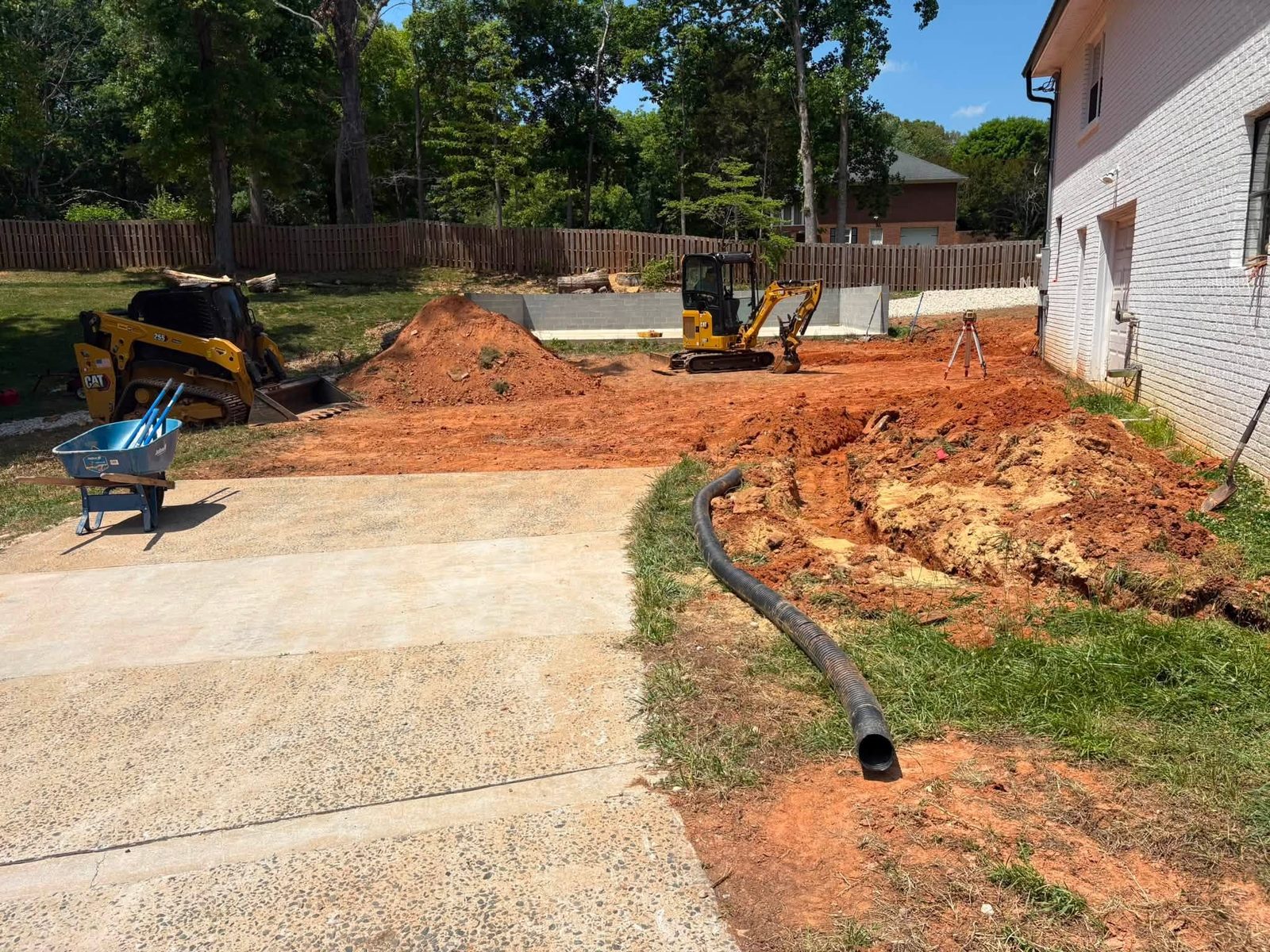
First, trench depth. Clay holds water at or near the surface for days after a storm. To place the pipe below the seasonally saturated zone, crews here routinely cut to 18 to 24 inches, where a sandier lot might call for 12. Every extra inch means more machine time, more spoil to haul, and more surface restoration after.
Second, aggregate volume. The gravel envelope surrounding the perforated pipe does the actual drainage work. In fast-draining soils, a thin stone column is enough. In Forsyth County clay, that envelope needs to be wider and consistently packed with washed stone, because the surrounding soil is not helping move water. Fabric-sock shortcuts that pass muster elsewhere clog faster here.
Third, outlet engineering. Sandy lots often have natural infiltration points close to where the pipe terminates. Clay lots rarely do. Most Forsyth County installs require the outlet to reach a constructed swale, storm drain, or daylighted slope at the property edge, adding footage and sometimes grading work that a per-foot quote written for different soil never accounts for. If the yard already runs toward the foundation rather than away from it, the outlet route gets longer still; see how that shapes a full drainage plan on our yards that slope toward the house page.
Forsyth County's storm history makes the engineering stakes real. FEMA has recorded 22 federal disaster declarations touching this county over 1977-2026, most of them storm and flooding events. A French drain that is too shallow, or that outlets into ground the clay will never drain, backs up exactly when you need it most.
Actual price ranges for Forsyth County installs
Forsyth County's neighborhoods cover a wide range of lot ages, sizes, and grading conditions, and the cost spread reflects that. A newer subdivision lot in Clemmons with a defined swale at the property line is a different job than a 1970s ranch in western Winston-Salem where the outlet has to travel 60 feet to reach anything usable. Both are normal Forsyth County installs; neither prices like the national average you find on a lead-gen calculator.
| Scope of work | Typical Forsyth range | What drives it |
|---|---|---|
| Basic run, 50–75 ft | $3,000 – $5,000 | trench depth, outlet type, surface restoration |
| Standard run in clay, 75–150 ft | $4,000 – $7,500 | aggregate volume, clay depth, outlet reach |
| Complex run with catch basin or multiple outlets | $5,500 – $9,000 | outlet structure, grade engineering |
| Full yard system, multiple runs | $7,500 – $12,000 | total footage, multiple outlets, coordination |
| Per linear foot, installed (accessible run) | $25 – $55 | depth, backfill spec, fabric, pipe size |
Those ranges cover complete, working systems: trench, pipe, aggregate, fabric, outlet structure, and surface restoration all included. A quote that shows only a per-foot line is pricing the pipe-and-gravel portion of the job. The outlet connection, any catch basin, and lawn repair after are separate costs in a per-foot-only bid. A number that looks 20 percent lower often gets there by leaving the outlet off the page entirely.
Permits, stormwater rules, and where regulations begin
Most residential French drain installations in Forsyth County do not require a building permit for the drain itself. What triggers permit or regulatory requirements is what happens at the outlet and how much land is disturbed to get there.
The rule that catches the most homeowners: any land disturbance of one acre or more requires an erosion and sediment control permit under North Carolina state rules, administered by the NC DEQ Erosion and Sediment Control program. Most residential French drain projects stay well under that threshold, but a full regrading combined with drainage work on a large lot can reach it.
When the outlet connects to county storm drain infrastructure, Forsyth County's stormwater program requires coordination before that connection is made, regardless of project size. A contractor who treats that coordination as optional is leaving you with a potential inspection failure and an unrecorded tie-in to public infrastructure.
For commercial properties, or any project where the disturbed drainage area reaches a waterway regulated as Waters of the State, the EPA's NPDES stormwater permit program may apply. Most single-family Forsyth County projects never approach that threshold, but a larger parcel or commercial site needs to address that question before design begins, not after the trench is already open.
Reading a per-foot quote before you sign it
A per-foot price tells you almost nothing about a French drain until you know what depth, material, and outlet destination it assumes. Three questions clarify any quote:
- What is the specified trench depth and width? Ask for the cross-section dimensions. For Forsyth County clay, a spec shallower than 18 inches needs an explanation. A bidder without a cross-section spec is guessing at the most important variable.
- What aggregate and fabric spec is included? The baseline for clay soils is clean washed stone with a woven geotextile filter fabric wrapped around the stone column, not just the pipe. A fabric sock on the pipe alone cuts upfront cost and accelerates clogging in fine clay within a few years.
- Where does the outlet go, and is that included in the price? The outlet destination — whether a pop-up emitter, a catch basin, a swale connection, or a storm drain tie-in — is where the actual drainage engineering happens. Make sure that structure and the footage to reach it are in the quoted price, not treated as a post-contract add-on.
A full installation scope, from trench layout through outlet selection and surface restoration, is covered in detail at our French drain installation guide. If pooling is already a visible problem, the diagnostic steps in standing water in the yard can help you define the drain route before you request a first quote.
Matching the fix to the actual problem on your lot
French drains fix one specific problem: subsurface water moving through the soil toward or beneath a structure. They are not the right tool for surface water that sheets off during heavy rain and runs across the yard before it ever soaks in. That problem belongs to grading, swales, or berms, and adding a French drain on top of a grading problem does not resolve it.
A useful field test: watch your yard during the first ten minutes of a moderate rain. Water moving across the surface in visible channels points to a grading or surface drainage problem. A yard that looks normal during rain but stays spongy and saturated for two or three days afterward is a subsurface saturation problem, and a French drain addresses that directly.
Winston-Salem has both conditions, often in the same neighborhood. Older areas in the western and northwestern parts of the city frequently show grade changes that accumulated over decades of additions, patios, and landscaping shifts that redirected original drainage paths. Newer subdivisions on the outer county, including parts of Lewisville, sometimes present the opposite: aggressive finished grading that sheds surface water quickly but leaves subsoil compacted and slow to drain. Many Forsyth County lots carry both problems layered on the same property.
Getting the diagnosis right before designing the fix prevents paying for a correction twice. If your lot already slopes toward the house, that grade issue needs to be part of the drain design scope from the start, not something addressed as a separate project after the drainage work is in the ground.