Davie County clay and what it does to a drainage job
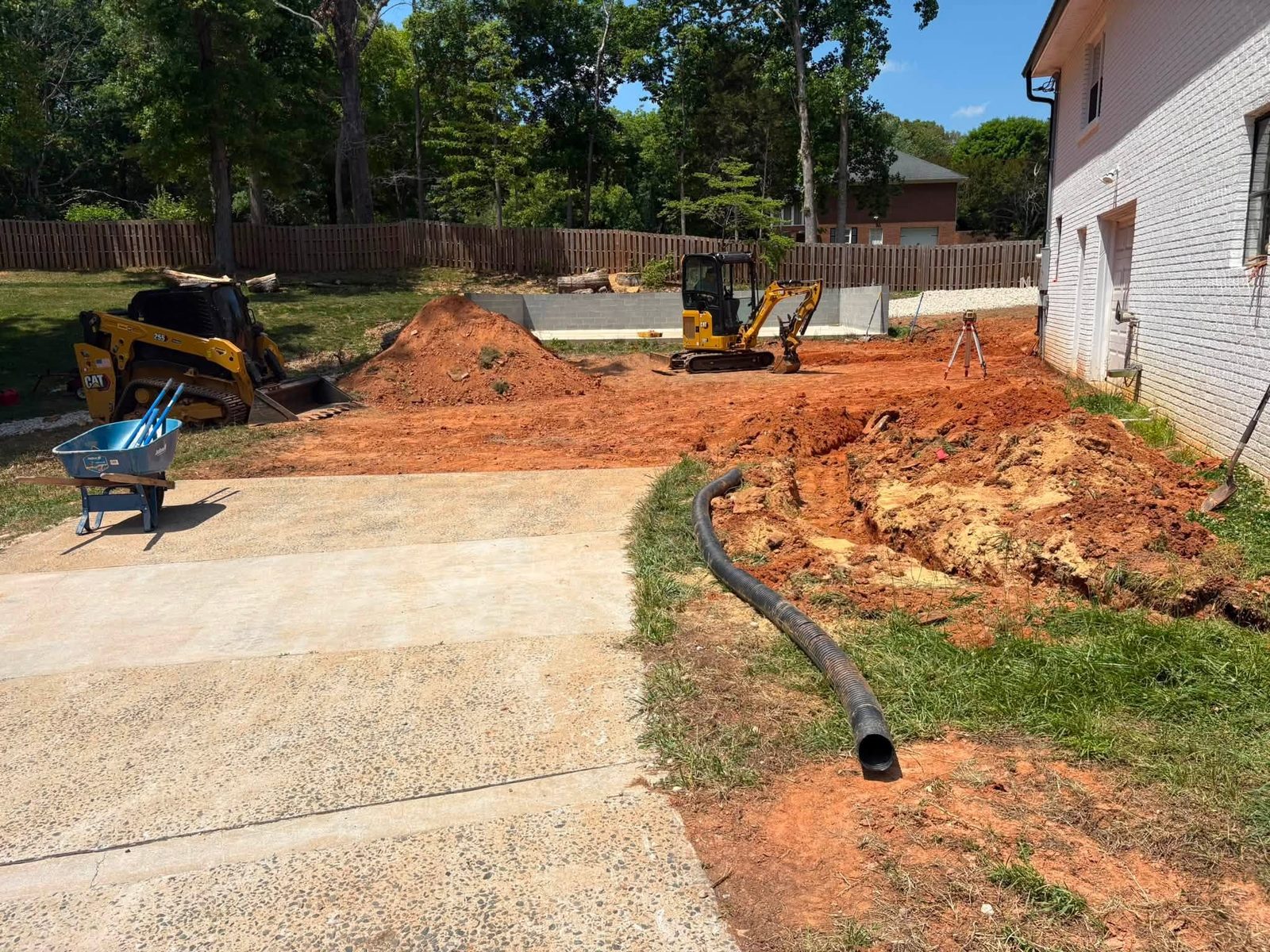
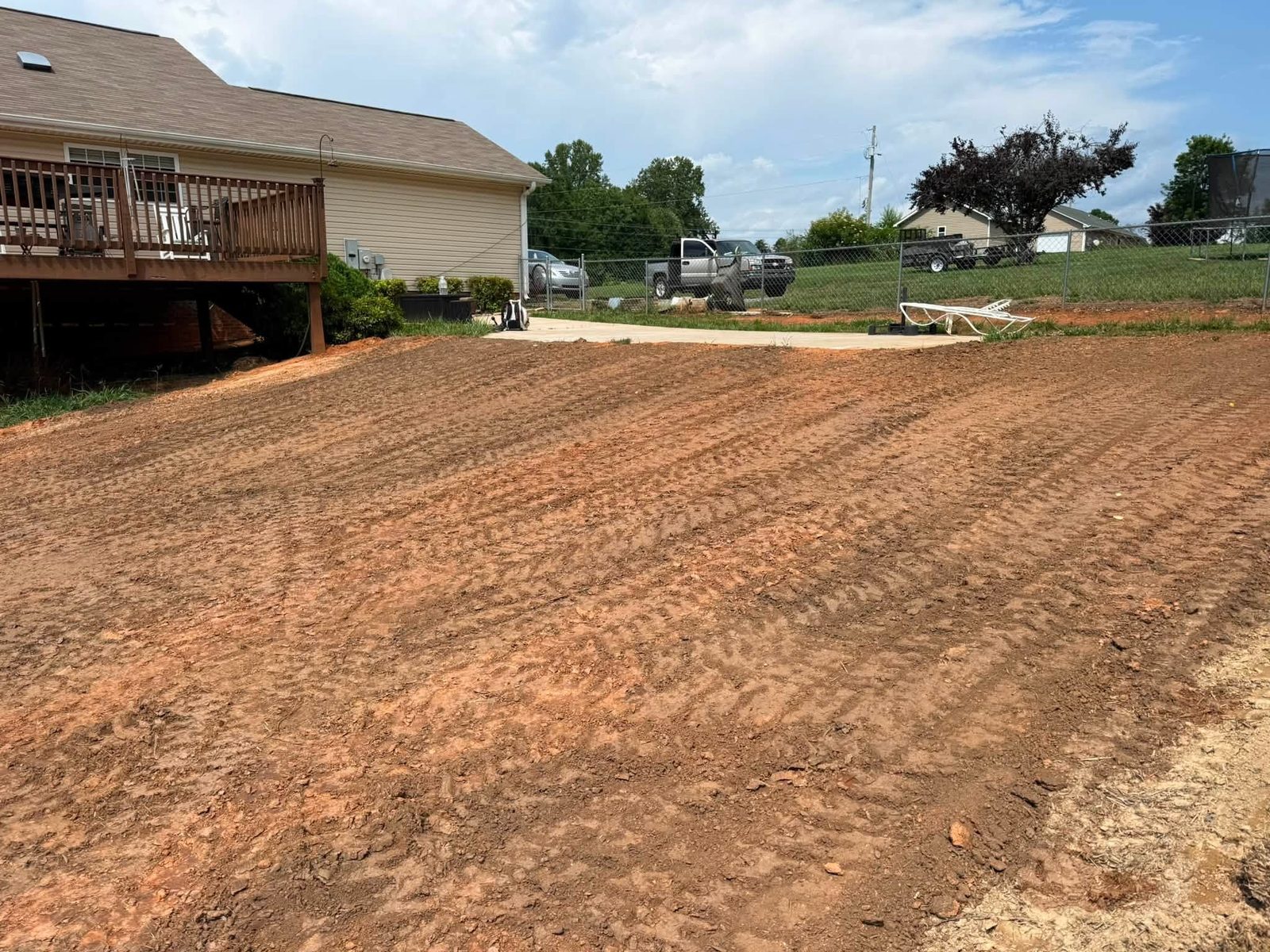
Most of Mocksville's residential lots sit on Piedmont red clay, a dense, low-permeability subsoil that behaves more like a bowl than a sponge. Rain that falls here doesn't soak away in an afternoon; it collects on the surface, saturates the top few inches of soil, and moves laterally until it finds the lowest point available. That point is often a foundation wall, a crawl space skirting, or a back corner of the yard that stays wet through March.
In-town lots near the Mocksville courthouse square frequently have grading that has settled toward the structure over decades of clay shrink-and-swell cycles. Newer subdivisions along the I-40 corridor often carry lot grading engineered to county drainage averages rather than calibrated to the specific low-corner problem on your parcel. Properties out toward the Yadkin River bottom deal with a different challenge: runoff from uphill and seasonal saturation that surface grading alone can't redirect. A French drain installation in Mocksville, NC has to account for which of these conditions it's actually working against.
What the work costs in Mocksville
Scope and clay depth are the two price movers on any Davie County drainage job. The full French drain cost breakdown covers line-item ranges; the working table is below.
| Scope | Typical Range | What drives the number |
|---|---|---|
| Single curtain drain (40–100 LF) | $3,000–$6,500 | Trench depth, clay hardness, outlet distance |
| Multi-run system with multiple inlets | $5,500–$12,000 | Collection point count, pipe sizing, catch basins |
| Downspout integration and pop-up emitters | $1,200–$3,500 | Emitter count, distance from structure |
| Catch basin installation (per basin) | $900–$2,500 | Depth, pipe connections, grate type |
| Outlet trench to street or road ditch | $1,500–$4,000 | Distance, right-of-way requirements |
| Whole-yard drainage regrading | Starting ~$15,000 | Square footage, clay depth, final grade |
Jobs at the higher end of these ranges usually reflect either a long outlet run to a legal discharge point or the excavation cost of cutting through compacted clay at depth. If standing water in your yard is the immediate issue, identifying the outlet location is the first step before any trench line is planned.
Reading the site before any trench goes in
Drainage problems have a source (the uphill catchment, the downspout volume, the adjacent lot's grading) and a victim: the wet corner, the soggy lawn, the damp foundation wall. Correctly identifying both before a contractor visits prevents the common outcome where a new drain solves one wet spot and creates another twenty feet away.
For clay-soil sites, a useful site assessment covers three questions: where does water enter the property boundary (roof runoff, surface flow from neighboring lots, or both); where does it collect and in what volume; and what outlet options exist within reasonable distance. Outlet options in Davie County typically include roadside ditches with NCDOT right-of-way approval, detention swales on larger rural parcels, or discharge to a drainage easement at lower elevation. Properties with no clean outlet within 150 feet of the wet area are candidates for a dry well or infiltration trench, which work with limited clay-soil permeability rather than fighting it.
For any parcel near the Yadkin River corridor or a low-lying section of Davie County, checking the FEMA Flood Map Service Center before finalizing an outlet design takes minutes and can change the scope significantly. A parcel inside a Special Flood Hazard Area has drainage constraints that standard residential installations don't anticipate.
Permits, erosion rules, and the outlet question
Drainage work in Davie County operates under North Carolina's statewide erosion and sediment control framework. The NC DEQ Erosion and Sediment Control program sets the threshold: land-disturbing activity of one acre or more requires an approved erosion control plan before work begins. Most residential drainage jobs fall below that threshold on their own, but larger lots or work combined with other site grading can approach it.
The outlet question carries its own regulatory layer. Any drain discharging to a NCDOT roadside ditch requires prior right-of-way approval; drainage routed toward a neighboring property's surface must not create a nuisance or accelerate erosion on the receiving end. The NC Department of Insurance building codes division enforces the IRC's residential grading provisions; on permitted construction, foundation drainage grades are an inspected item. A drainage contractor who can't explain which outlet situations require county or NCDOT approval in Davie County hasn't done enough legitimate work here to trust with a complex scope.
The federal disaster record for Davie County counts 19 declared events across 1977-2026, concentrated in storm and flooding categories. The regulations exist because the water risk is real and documented.
What separates a drain that lasts from one that silts in
The failure mode for French drains in Piedmont clay is almost always aggregate specification rather than pipe failure. Fine-grain gravel or bank-run stone packs under load in clay-heavy soil, loses void space, and the perforated pipe silts in within a few years. Properly specified drainage aggregate (clean No. 57 stone or equivalent, wrapped in nonwoven geotextile filter fabric) holds its drainage capacity for decades because the fabric keeps clay fines out of the void space.
Installation markers worth asking about before a crew starts: Is the trench bedded in aggregate before the pipe is set? Does the geotextile wrap the full aggregate envelope rather than just the pipe? Does the outlet daylight cleanly above the normal high-water mark of wherever it terminates, so a wet-season event doesn't back up the system? The complete French drain installation guide covers outlet types and setback distances specific to North Carolina conditions, including the Piedmont clay profile common throughout Davie County.
How to read drainage bids in this market
Two practical checks before signing a drainage contract in Mocksville: first, ask whether the contractor is pulling applicable county permits and whether they have confirmed the outlet location with NCDOT or Davie County if it discharges to a public right-of-way. A crew that has done this legitimately before will answer without hesitation. Second, ask for the outlet plan in writing. A bid that describes the inlet trench in detail but leaves the outlet as "to existing drainage" hasn't solved the drainage problem yet.
Clay-heavy soils also change how you evaluate bids on price. A quote that lands significantly below others in this market may be cutting aggregate depth or using undersized pipe to hit a number. The long-term cost of excavating and rebuilding a failed drain system in Davie County clay exceeds the cost of specifying it correctly the first time.