Clay sets the terms in Forsyth County
French drain installation across NC Piedmont lots begins with one fact about Forsyth County that any experienced drainage crew either knows or learns quickly: the red clay soil here does not drain passively. Water that moves through in a few hours on a sandy Coastal Plain lot sits for two or three days in a Winston-Salem yard, working its way to the lowest point — a foundation wall, a crawl space sill, a corner the original builder filled without compacting properly. That soil behavior is the starting constraint of every drainage job in the Triad, and any scope that ignores it is likely to fail within a season or two.
Forsyth County's mix of post-war ranches, 1980s cul-de-sac subdivisions, and newer infill lots means many yards were graded just enough to pass the original inspection — not enough to reliably shed water once landscaping, settlement, and time softened the original slopes. Grade, clay, and construction compaction compound each other. If you are already seeing standing water in your yard after normal rainfall rather than exceptional storms, the site has probably been fighting its own drainage for years. With 22 federal disaster declarations recorded here across 1977-2026, saturated-ground events are a recurring reality in this county, and they expose every marginal drainage decision made during original site work.
What a French drain handles — and where it stops
A French drain intercepts water at a specific point — along a foundation wall, at a low-yard collection zone, across a slope that sheds runoff toward a structure — and moves it to a confirmed outlet. Done well in Forsyth County clay with the right filter-fabric specification and a real outlet, a correctly installed system lasts decades. The pipe and gravel are commodity materials; what you are buying is the read on where the water comes from, where it needs to go, and what the soil will do to the system over time.
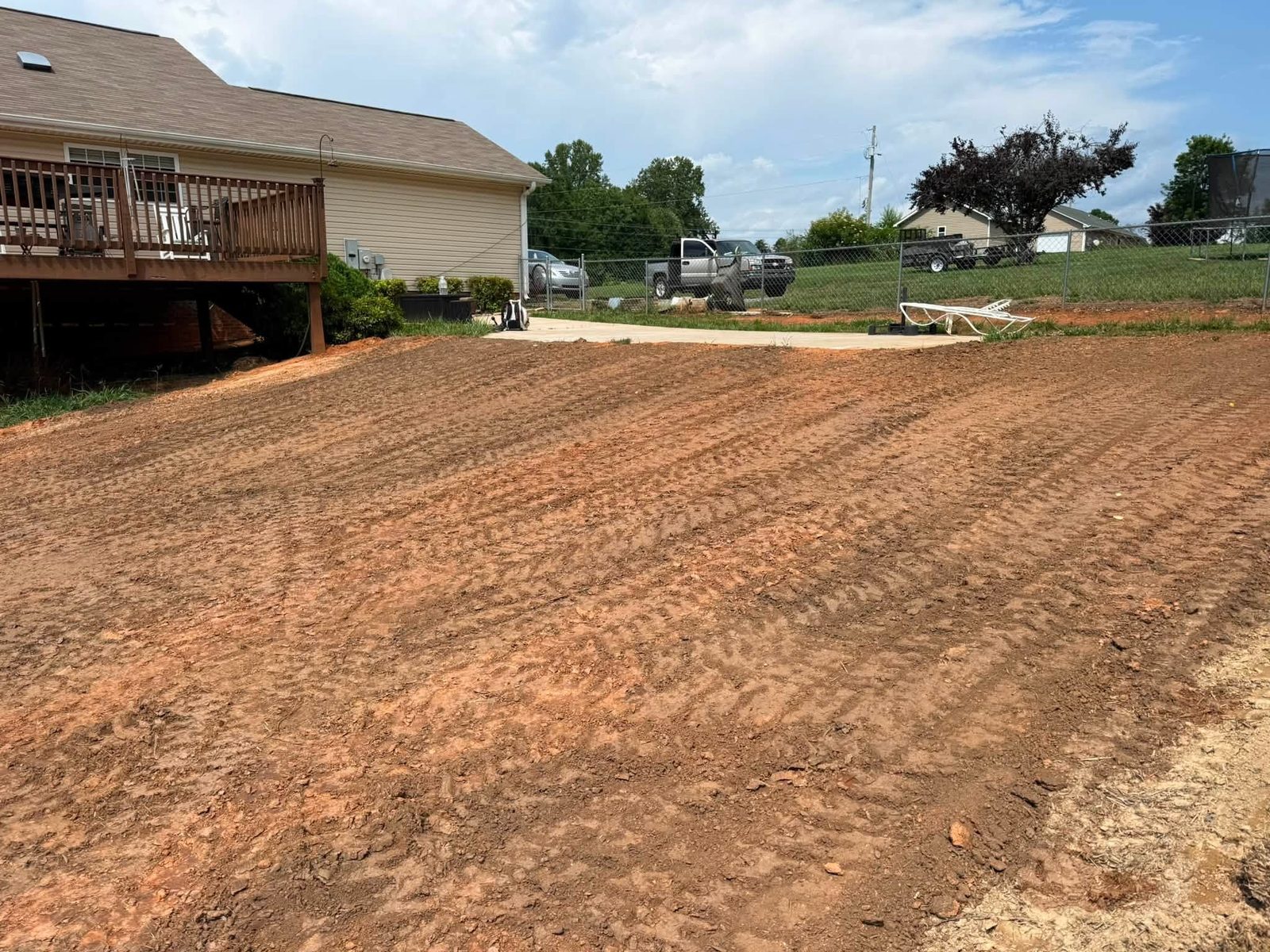
Where it stops: a French drain is not a grade correction. When the overall lot grade sends water toward the house, the durable fix usually requires reshaping the yard so water moves away before it reaches the wall. A perimeter drain can manage what regrading misses, but installing a drain against a persistent adverse grade is a recurring pattern that brings homeowners back for second jobs. Drainage and regrading are complementary, not interchangeable. Similarly, a French drain addressing groundwater at the foundation perimeter does not resolve a vapor problem inside the crawl space; those are separate systems with separate solutions. See the detailed cost page for how the scope decision changes the final price.
How a drainage job actually gets done
A typical Forsyth County residential French drain project runs one to three days:
- Outlet confirmation first. The outlet — where water physically leaves the property — has to be verified before any trench is dug. Connections to roadside swales or public storm systems often require a permit from NCDOT; some Forsyth County grading and drainage work also triggers local building review. Without a confirmed outlet, the trench is a holding tank, not a drain.
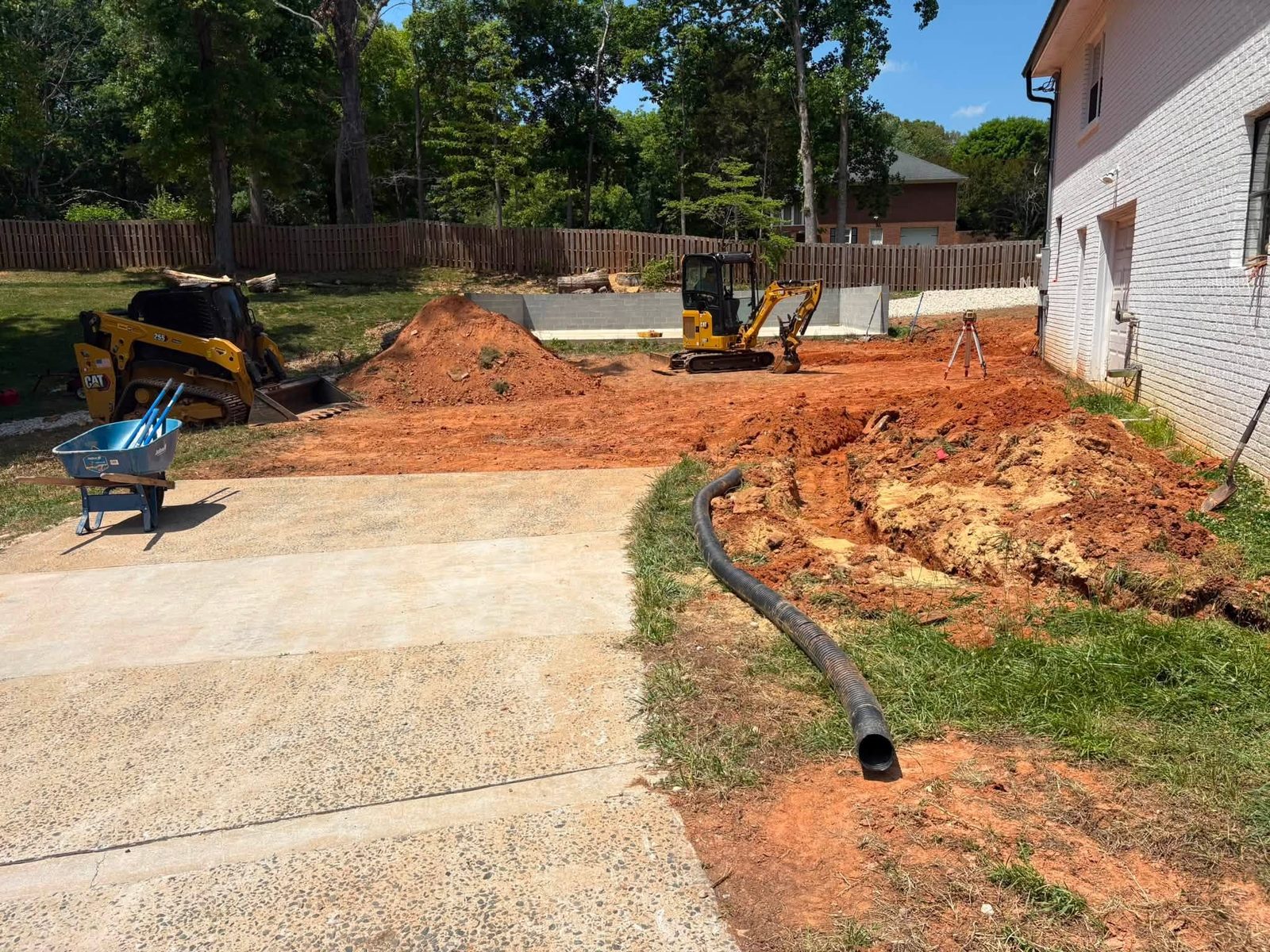
- Slope layout and staking. The full run needs consistent fall — typically at least 1% grade — to move water rather than pool it. This gets measured, not estimated. Forsyth County's rolling terrain usually provides workable slope; the crew needs to find it and use it, and the grade calculation is something that should be available on paper before the first shovel hits ground.
- Trenching and filter fabric. Trench depth and width depend on the water source and flow volume. Filter fabric lines the entire trench to prevent Piedmont clay fines — the fine particles red clay sheds under pressure — from migrating into the gravel over time. Skipping or underspecifying the fabric is the single most common cause of early failure on clay-soil drainage jobs.
- Aggregate, pipe, and backfill. Not every application requires perforated pipe; aggregate-only systems handle lower-flow surface drainage. Larger projects that disturb significant ground area fall under NC DEQ erosion and sedimentation control standards, and projects disturbing an acre or more trigger EPA NPDES stormwater permitting. Stabilizing disturbed soil after completion is part of the job, not an optional add-on.
What drainage work costs in Forsyth County
Drainage pricing in this region follows scope and clay depth more than any other single variable. The table below reflects what honest residential work actually runs in the Triad; see the full cost page for a granular breakdown of what drives the number on your specific lot.
| Scope | Typical Range | Primary cost drivers |
|---|---|---|
| Single French drain run (30–60 ft) | $3,000–$5,500 | Outlet type, clay density, depth to daylighting |
| Foundation perimeter drain | $5,500–$9,000 | House footprint, access restrictions, tie-in scope |
| Yard system (multiple drains and swales) | $6,000–$12,000 | Lot size, number of outlets, grade complexity |
| Full-lot regrade with drainage | $15,000+ | Volume of soil moved, finished-grade certification |
Forsyth County clay consistently pushes single-run jobs toward the upper end of their range: trenching through compacted Piedmont red clay takes longer than sandy soil, dry-well percolation tests frequently come back marginal in heavy clay, and filter-fabric specification is more critical here than in regions with natural drainage capacity. A mid-range Triad yard drainage project — two or three intercept trenches, a verified outlet, a corrective swale — reasonably runs $8,000–$11,000.
Three questions that keep a drainage bid honest
"Where does the water go when it leaves the pipe?" The outlet is the only part of a French drain that actually removes water from your property. A bid that describes trench length and pipe diameter but gives no confirmed outlet location is incomplete. A system that terminates in a dry well sunk into Forsyth County clay without a verified percolation test produces a tank that fills and stays full. Ask for the outlet location and how it was confirmed before any work starts.
"What is the slope along the full run, and can I see the math?" Drainage pipe needs consistent fall for water to move. Forsyth County's rolling lots usually provide workable grade somewhere — the question is whether the crew found it and measured it, or assumed it. A contractor who can hand you a slope calculation on request has measured. One who says "it will drain fine" without documentation has not.
"Does this scope need a permit, and who pulls it?" Certain grading and drainage projects in Forsyth County require local permits; connections to roadside ditches fall under NCDOT driveway and access rules. NC's building code framework, administered through the NC Department of Insurance, sets the standards local inspections enforce. A contractor who answers "we never pull permits for drainage" without knowing the specifics of your job is not answering the question — they are dismissing it.