Where tobacco fields become building lots
Tobaccoville sits in northern Forsyth County where former tobacco farm holdings have been converting to residential parcels for a generation. That legacy shows up on a typical clearing job as old fencerow thickets of locust and cedar, mature hardwood stands that survived cultivation, and secondary growth reclaiming former field edges. Beneath all of it is the Piedmont's red clay subsoil: stable when covered, erosive the moment vegetative cover comes off.
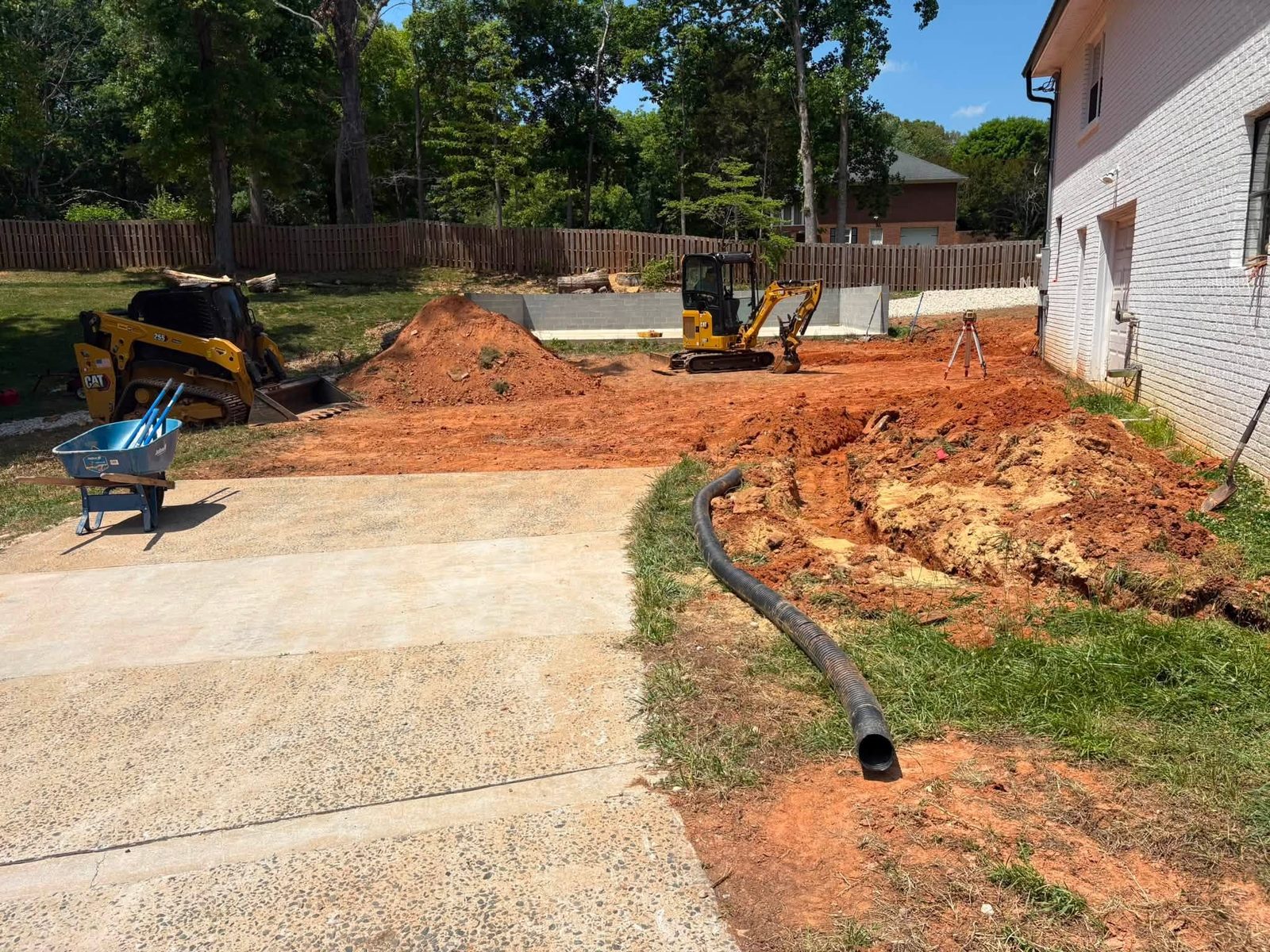
That clay distinction drives the job sequence here more than on most suburban lots. Conventional clearing crews work top-down — fell, chip, grade — but on a Forsyth County lot with disrupted drainage from old field patterns, grading without a prior drainage review can redirect sheet flow toward foundations or neighboring properties in the first heavy rain. This work is properly called site preparation, and it runs in a specific order: drainage review first, then selective clearing, then finish grade.
For a complete picture of what clearing involves from lot evaluation through final grade, the land clearing overview covers every phase. Tobaccoville lots add one layer that suburban Winston-Salem infill jobs often skip: what the field used to drain toward, and whether that pattern still works for a house lot.
What the scope drives — a working price table
Every land clearing job in Tobaccoville starts with the same question: what exactly needs to come off, and what needs to happen to the ground afterward? Tree density, stump disposition, slope, and finish grade requirements each move the number independently. The table below maps common residential and small-acreage scopes to realistic price ranges for this area.
| Scope | Typical Range |
|---|---|
| Light brush and understory, under half an acre | $750 – $1,500 |
| Full lot clearing, mixed hardwoods, stumps left | $1,500 – $3,000 |
| Full lot clearing with stump grinding | $2,500 – $5,000 |
| Acreage clearing with stumps and finish grading | $4,000 – $8,000 |
| Heavily wooded multi-acre site, full site prep | $8,000 – $10,000+ |
Those ranges hold for moderately rolling Forsyth County terrain with reasonable equipment access. Rocky outcrops, standing drainage, or restricted access from a narrow shared drive push jobs toward the top of each band. Whether debris leaves the property or gets chipped in place also separates quotes that look similar on lot size alone. Scope creep is the most common reason clearing bills run higher than the initial quote — getting stump disposition and debris handling decided before a quote goes to paper prevents the largest surprises. For the full line-item breakdown of every cost driver, the land clearing cost guide is the place to start before you request a bid.
The erosion clock starts the day ground breaks
North Carolina's Sedimentation Pollution Control Act requires a Land-Disturbing Activity permit for any project that disturbs one or more acres, administered through the NC DEQ Erosion and Sediment Control program. Smaller Tobaccoville lots can still fall under local review when the disturbance area drains toward a stream buffer, a wetland corridor, or a permitted subdivision drainage system — worth confirming with Forsyth County before any equipment moves.
The practical implication for red clay Piedmont soil: bare ground becomes a sediment liability within one rain event. Silt fencing and sediment controls that go in before clearing starts take time off the back end, when unchecked erosion has to be corrected rather than prevented. On a Forsyth County lot being cleared for new residential construction, the building permit timeline is also separate from the land-disturbance permit — coordinating both at the start avoids holds after clearing is already complete. A crew that sequences erosion controls as a first step, rather than an afterthought, is managing the job correctly.
Larger projects — commercial clearing, infrastructure prep, or sites near jurisdictional waters — may trigger federal NPDES stormwater review under the EPA's construction general permit. That threshold is lower than most property owners assume. Forsyth County has seen 22 federal disaster declarations spanning 1977-2026, mostly storm and flooding events. Any lot with historic drainage problems or a mapped flood zone overlay should have those conditions flagged before clearing resets the surface grade.
When mulching fits better than hauling
On lots where tree density runs moderate and the goal after clearing is erosion control before seeding or sod, forestry mulching is worth pricing alongside conventional cut-and-haul. A forestry mulcher processes standing trees into chips in place — no separate debris removal, no multiple passes — and the chip layer that remains reduces sheet erosion during the work window considerably. It also avoids the open burn permits that local ordinance increasingly restricts.
The trade-off is clean grade. Mulching leaves a textured surface that establishes well under seed and straw but does not finish flat enough for a concrete slab or crawl-space foundation. For building lot prep that ends with a foundation pour, conventional clearing with stump grinding and haul-out remains the right call.
Tobaccoville lots converting from old field to residential lawn, or acreage being cleared in phases with erosion control between sessions, are the strongest candidates for the mulching method. Pricing it as a line item against the haul-out option is worth asking for in any quote request — the spread between the two often surprises property owners who assumed debris removal was always the cheaper path.
What a Forsyth County clearing crew should answer before you sign
Three questions separate site prep crews from tree-count crews. First: does the bid include a drainage review, or does it price by tree count alone? On a former-farmland Tobaccoville lot, the answer tells you whether the crew has worked this kind of ground before. Second: how do they handle the permit and erosion-control sequence — do they pull the land-disturbance permit themselves, or does that fall on the property owner? Third: what happens if the job uncovers standing drainage, buried debris, or an old field drain line mid-project? Scope changes after equipment is staged are where initial bids become significantly larger invoices.
Crews operating heavy equipment on residential lots carry real liability exposure. Confirming general liability and workers' compensation coverage before work starts is straightforward due diligence; the NC Department of Labor publishes the safety requirements that apply to ground-clearing operations regardless of project size. When you have site specifics ready — acreage, current tree and brush density, and intended use after clearing — use the form on this page to request a scoped estimate. A site visit is the only honest basis for a number.