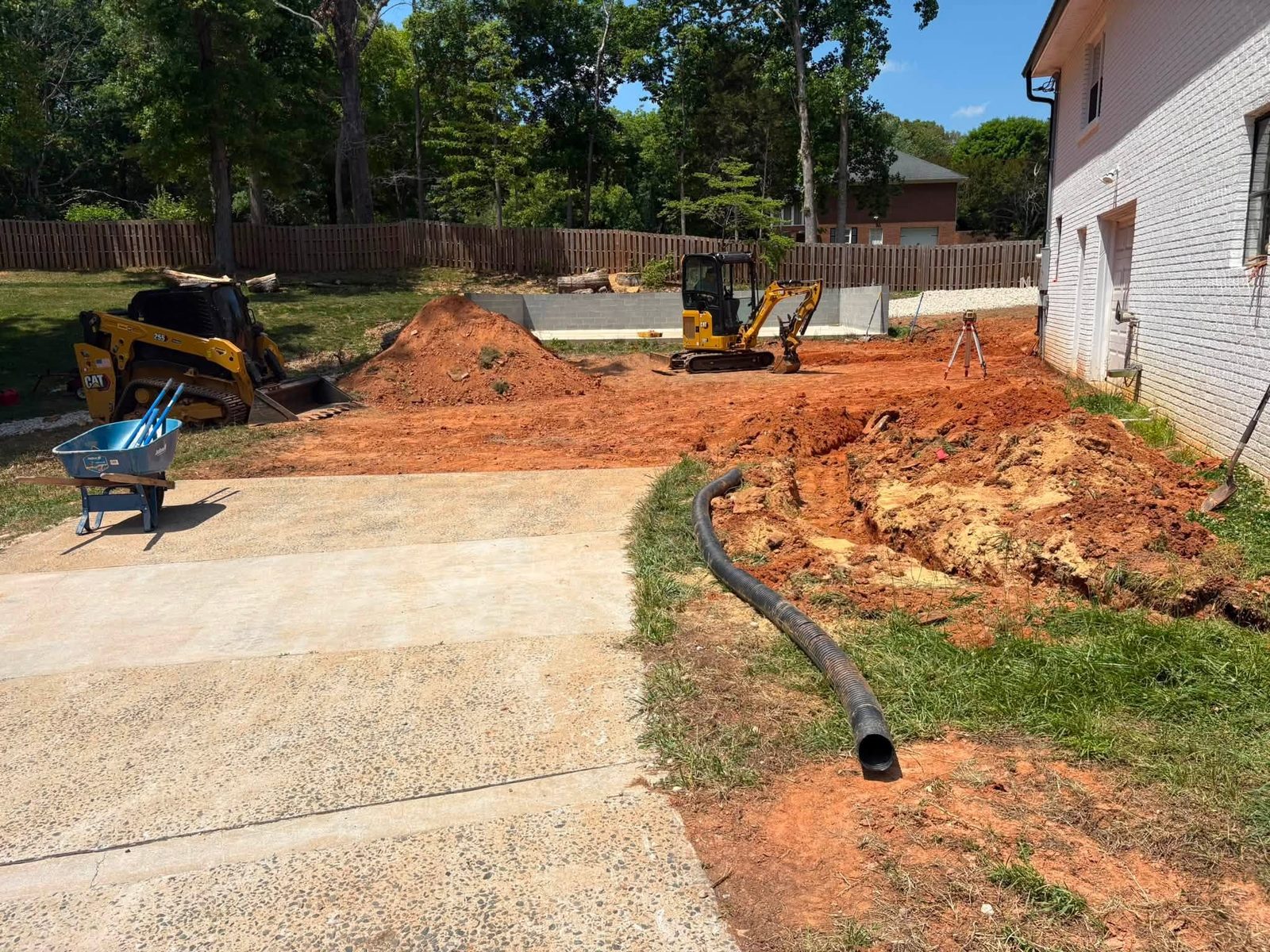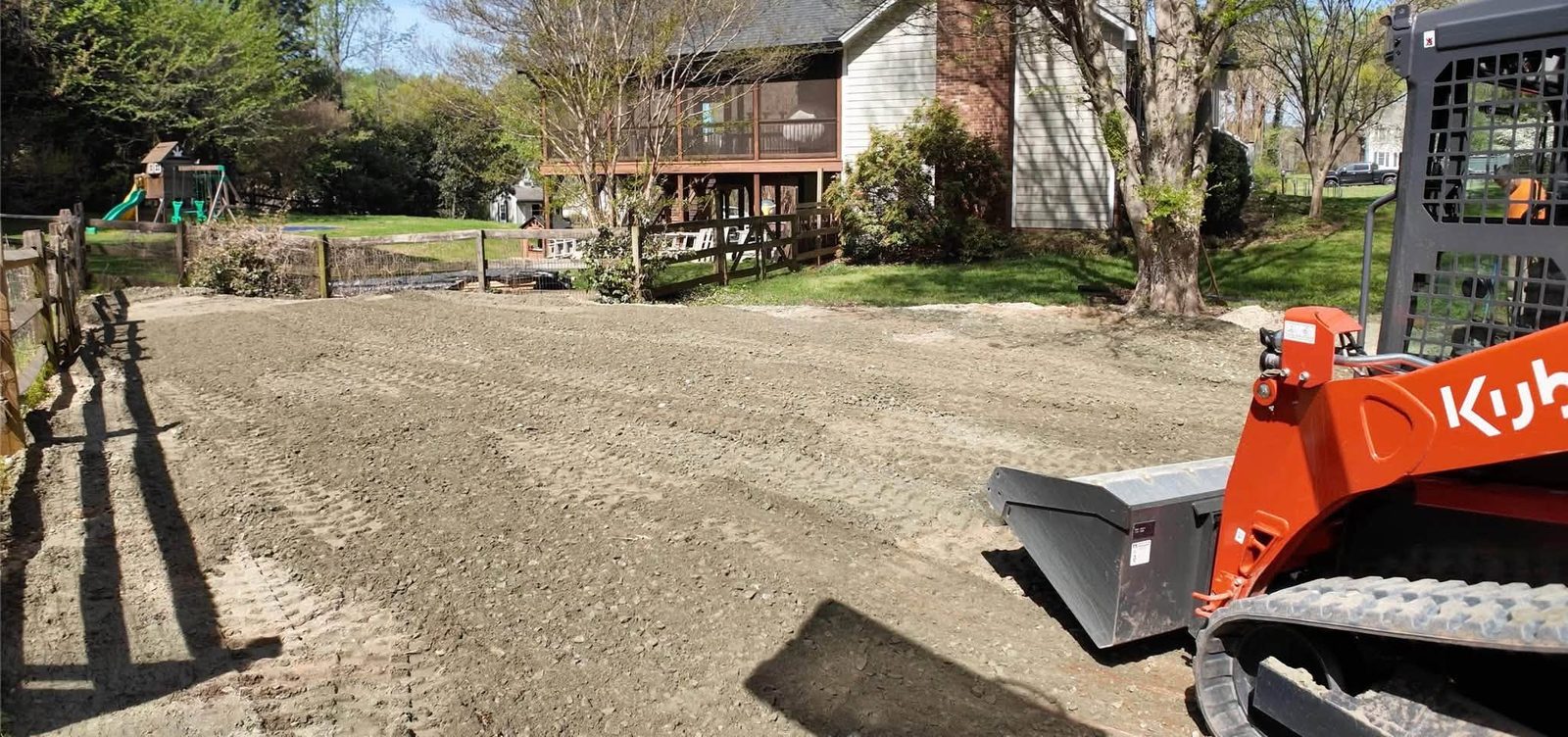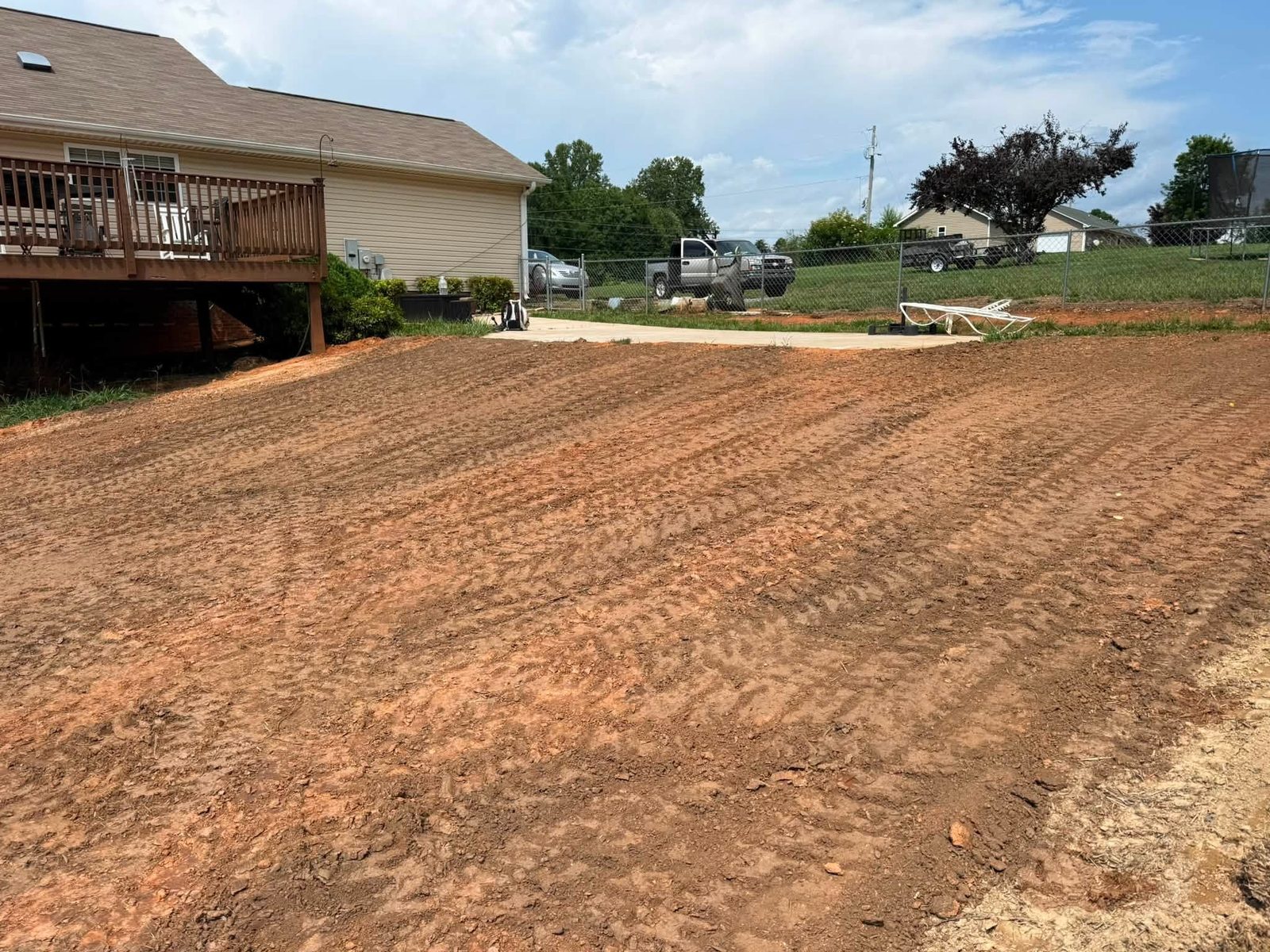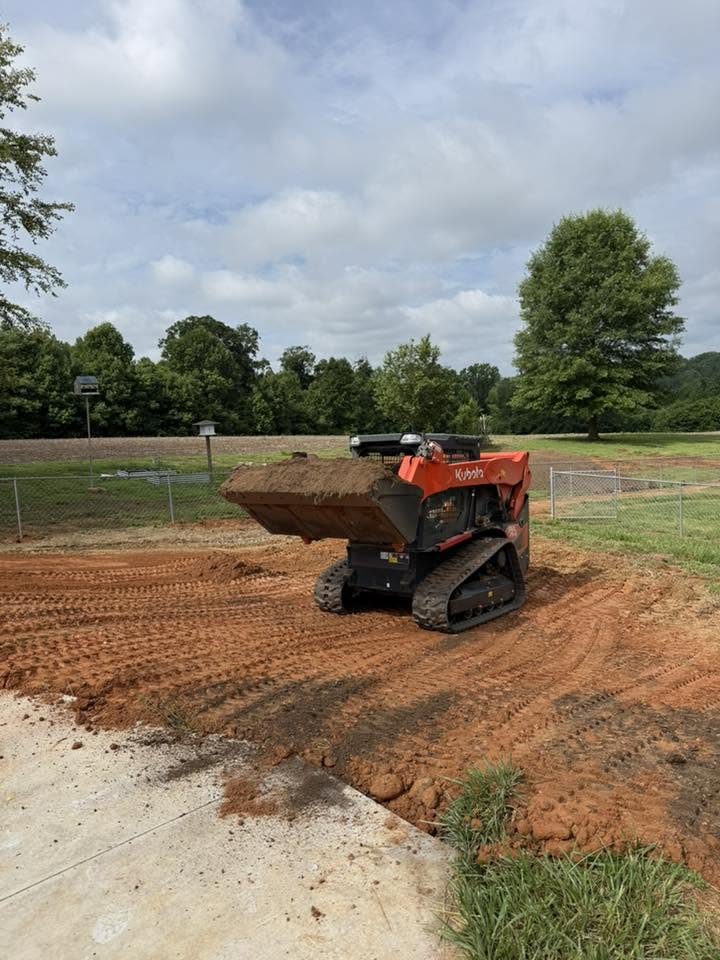
Piedmont clay is what every Clemmons grading job has in common
Clemmons is a Forsyth County suburb shaped by the same geology that defines most of the NC Piedmont: dense, slow-draining red clay that behaves differently depending on whether it rained three days ago. A grading contractor working a lot here isn't dealing with the loose sandy fill common to the coast or the rock ledge that slows mountain work — they're moving material that compacts inconsistently when wet, holds moisture long after a storm, and shrinks and swells with the seasons in ways that looser soils don't.
That changes how jobs get scoped and priced. Drainage corrections that would be straightforward on loam need more run and fall here. Fill pads for sheds, additions, or pools need more aggressive compaction to avoid settlement later. Established Forsyth County neighborhoods off Lewisville-Clemmons Road and around Tanglewood tend toward smaller lots, mature trees, and existing landscape that limits equipment access and adds hand-work time to every estimate. The full grading and excavation process has to account for all of it from the first site walk, not after the equipment arrives.
What residential grading work actually covers
Grading calls in Clemmons cluster around a handful of consistent scope types: drainage correction for standing water or a yard that pitches toward a foundation, rough site prep before a driveway, pad, or addition is built, finish grading after construction, and full-lot regrading for properties with significant slope problems or poor historical drainage. Each scope looks different on paper and prices differently on the ground.
The site preparation phase — rough grading, subgrade compaction, and drainage direction — is the work with the most downstream consequence. A lot graded to the wrong finished elevation before a concrete pour or foundation is set can create drainage problems that cost far more to correct after the fact than to prevent upfront. Getting the contours right, positive slope away from the structure, drainage channels placed where water needs to go, and compaction that matches what the structure above it requires is the job before the job.
What grading costs in the Clemmons area
Residential grading in Clemmons typically runs $1,200 to $5,500 for a standard lot, with larger regrades or sites requiring significant fill hauling past that range. The full grading cost breakdown covers what drives the spread, but the short version: equipment access, total material volume, whether fill is coming in or going out, and how much finish work the site needs after rough grade all move the number.
Any estimate that bundles equipment, labor, haul-off, and fill delivery into a single line without separating them is harder to evaluate honestly. Clay excavated from one part of a yard often cannot be reused as structural fill elsewhere without amendment — if a contractor isn't accounting for trucking, that cost is sitting somewhere in the number regardless.
| Scope | Typical Range |
|---|---|
| Drainage correction, single low spot | $1,200 – $2,200 |
| Foundation regrading (away from structure) | $1,500 – $3,000 |
| Driveway base prep or regrade | $1,800 – $3,500 |
| Lot rough grade before construction | $2,500 – $5,500 |
| Major regrade with significant fill hauled in | $4,000 – $8,000+ |
What Forsyth County requires before breaking ground
North Carolina's statewide erosion and sediment control program — administered by the NC DEQ Erosion and Sediment Control division — applies to any land disturbance over one acre. Most residential grading jobs in Clemmons stay under that threshold, but lot-clearing projects or multi-lot work can cross it. For larger commercial or multi-family sites, federal NPDES stormwater permit requirements through the U.S. EPA stack on top of state rules.
Below the one-acre trigger, Forsyth County's local permit and inspection process still governs finished grade, drainage, and slope compliance for work tied to a permitted structure. Contractors who wave off permit questions on jobs that materially change drainage around a foundation are giving incomplete advice, not saving you hassle.
Forsyth County's flood history is part of the picture here: 22 federal disaster declarations span 1977-2026, many of them tied to storm and flood events that pushed water at exactly the residential drainage systems grading work affects. Properties near the Yadkin River corridor or any mapped floodplain may carry additional fill and grading restrictions — the FEMA Flood Map Service Center is the first place to check before scoping work on those parcels.
What to ask before a Forsyth County grading crew mobilizes
Three questions worth getting answered before any grading work starts on a Clemmons lot: whether the crew pulls the permits the job requires (a vague answer is an answer), how they protect your site during active work when it rains — Piedmont clay that's been cut and left unfinished moves fast in a Forsyth County storm — and whether the scope document spells out finished drainage direction, not just cut and fill volumes.
For grading tied to a permitted structure, NC contractor licensing applies. The NC Department of Insurance building codes division and the NC Licensing Board for General Contractors are the verification points for licensure on larger site work; projects tied to construction — foundations, retaining walls, permitted additions — generally don't fall under small-job exemptions, regardless of how the work is described.
Experience with Winston-Salem metro area clay matters in ways that don't show up on a license. A crew that has worked Forsyth County soils knows to schedule compaction passes when soil moisture is right, not just when the calendar opens up — and knows that a finished grade that drains cleanly in October may behave differently after the first hard winter rain pushes through the Piedmont.