Why Forsyth County clay rewrites the drainage playbook
Rural Hall sits on the northern edge of Forsyth County's Piedmont plateau — gently rolling lots carved from what was once farmland, with a soil profile that still behaves like it. Cecil and Appling clay loams dominate this part of the county, and they drain at a fraction of the rate of coastal sands or mountain decomposed granite. Rain that vanishes overnight in other parts of North Carolina can sit on a Rural Hall lawn for two or three days.
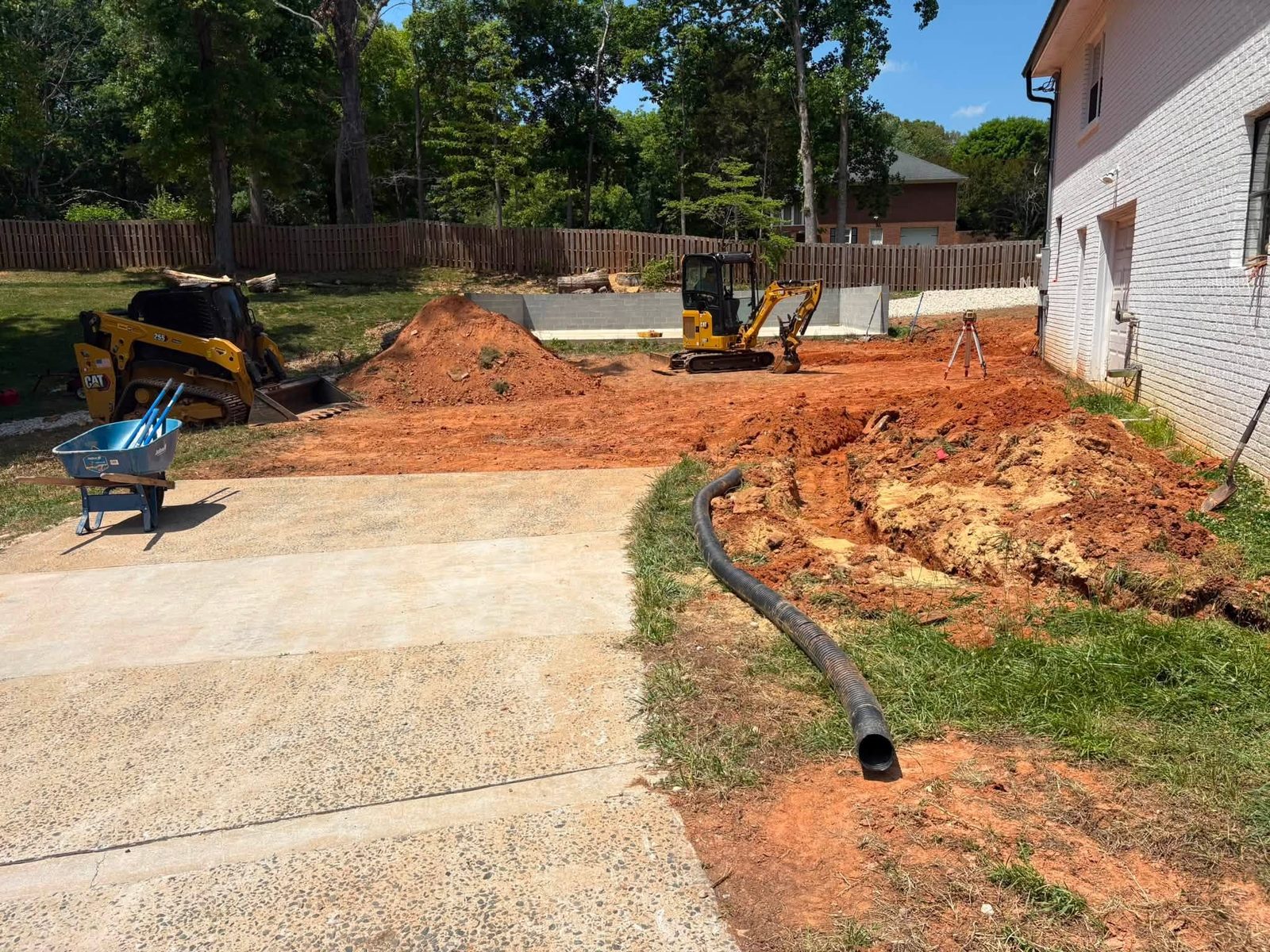
That timeline rewrites how drainage work gets specified here. In well-draining soil, a standard perforated pipe and gravel trench can disperse water back into the ground along the run itself. In dense Piedmont clay, that same installation becomes a collection pipe with nowhere to go unless the outlet is positioned at a genuine grade break, a storm drain connection, or a roadside ditch. A French drain that terminates in clay is a French drain that eventually backs up.
The outlet question — where does the water go after the pipe — is what separates a successful Rural Hall drainage job from one that has to be redone. Before any trench is opened, a contractor who knows this county locates the outlet, confirms the elevation drop, and designs the run backward from there. That sequence is the whole job.
What scope drives cost in Rural Hall
Most residential French drain installation in Rural Hall lands between $3,500 and $12,000 depending on run length, outlet complexity, and how much existing grade needs to change. The full line-item breakdown lives at French drain cost for NC homeowners; the table below covers the scope ranges that come up most often in Forsyth County.
| Scope | Typical Range |
|---|---|
| Single trench run (50–100 ft), daylight outlet | $3,000 – $5,500 |
| Single run with dry well or pop-up emitter | $4,500 – $7,500 |
| Perimeter drain around foundation, existing grade | $5,000 – $9,000 |
| Multiple collection runs, minor regrading | $7,500 – $12,000 |
| Full-yard regrade with drainage system | Starting around $15,000 |
Clay soil adds cost in two distinct ways: it limits how far a run can travel before needing a discharge point, and it often rules out dry wells entirely because the surrounding soil cannot accept dispersed flow fast enough. When a dry well is not viable, the pipe must reach a storm drain channel or a ditch — and extra footage adds cost. Jobs near an existing Forsyth County storm drainage easement generally price toward the lower end of each range; jobs where the only viable outlet requires crossing additional lot distance or coordinating with a neighboring property can push toward the top.
What persistent yard water is actually telling you
A yard that stays wet for days after a normal rain is giving you diagnostic information worth reading carefully. The standing water in your yard guide covers the full decision tree, but the short version for Rural Hall properties: a wet spot that refuses to drain within 48 hours of moderate rain points to a grading or outlet problem — the soil is doing what clay does, and water is pooling at the lowest point it can reach. A wet area that migrates or appears during dry stretches is more likely a buried pipe failure or a clogged downspout extension.
Foundation proximity changes the urgency. Forsyth County neighborhoods platted in the mid-twentieth century — when lot grading tolerances were looser — often show foundation dampness that started as a minor yard drainage issue and compounded over decades. Water that regularly parks against a house is working on that foundation whether or not cracks are visible yet. Getting the yard drainage right early is a fraction of the cost of the remediation it prevents.
Permits, grading thresholds, and state rules that apply
Whether a standalone French drain requires a local permit depends on scope and Forsyth County rules — confirm before any work that directs water toward a neighboring lot, an easement, or county drainage infrastructure. In North Carolina, the NC DEQ Erosion and Sediment Control program requires an approved plan for land disturbance of one acre or more — a threshold most single-lot drainage jobs stay under, but one that matters for combined-scope projects involving swale installation, significant driveway regrading, or extensive yard reshaping.
Jobs that discharge to surface waters can trigger federal EPA NPDES stormwater requirements, particularly on commercial-adjacent lots or multi-lot work. For drainage tied to a new building or addition, grading provisions of the International Residential Code govern how finished grade must slope away from the structure; the International Code Council publishes the current standards that North Carolina has adopted into its residential building code.
Storm history and why drainage demand stays high here
Forsyth County has been touched by 22 federally declared disasters over 1977-2026, the majority of them storm and flood events. That record reflects a precipitation pattern familiar to anyone who has owned property in the Piedmont Triad for more than a decade: intense summer convective storms that deliver two or three inches of rain in under an hour, landing on soil that absorbs it slowly. The mismatch between precipitation intensity and clay infiltration rate is precisely the condition a well-designed French drain is built to manage.
The FEMA Flood Map Service Center carries the official flood zone designations for Rural Hall parcels. Most residential lots in town sit outside the 100-year floodplain, which means flood insurance is not mandatory for most homeowners — but it also means many have never had a formal drainage assessment. Clay is patient; a low spot that has always been that way is often a grading problem compounding quietly over years, not a permanent feature of the lot.
What to ask before a shovel touches your yard
The French drain installation guide walks through what a proper site assessment includes — outlet location, pipe sizing, gravel specification, and what happens to the water after it leaves the system. For Rural Hall properties specifically: ask whether the contractor has worked in Forsyth County's clay profile before (a bid that does not mention outlet location is not a complete bid); ask for a sketch showing where the water goes after the pipe ends; and confirm whether any county easements or storm infrastructure are affected by the outlet placement.
Grading and drainage contractors in North Carolina operate under licensing requirements for work above certain dollar and scope thresholds. The NC Department of Insurance publishes the current contractor licensing and bonding requirements that apply to excavation and grading work. A contractor who can show current licensure, a clear outlet plan, and references from Forsyth County clay-soil jobs is the one worth hiring.