What retaining walls actually cost in Forsyth County
Drive through Ardmore, Buena Vista, or the older subdivisions off Country Club Road in Winston-Salem and the same wall problem repeats itself: a concrete block retaining wall from a prior decade, now slightly bowed outward, efflorescence streaking down the face, and a weep hole that hasn't moved water in years. The Piedmont clay behind it never stopped moving. Replacing that wall, or building one correctly from the start, follows a predictable cost band in this county — but where a specific job lands within it depends entirely on what the subgrade is doing and how the lot drains.
| Scope of work | Typical Forsyth County range | What drives it |
|---|---|---|
| Small landscape block wall, flat lot, no drainage complications | $25 – $38 per sq ft face | wall under 4 ft, no clay pressure, no permit required |
| Standard block wall with drainage tile and gravel backfill | $38 – $52 per sq ft face | typical Piedmont clay lot, drainage system built in |
| Engineered block wall, 4 ft or taller | $48 – $60 per sq ft face | permit threshold, geogrid reinforcement, engineer's stamped plan |
| Natural stone or boulder wall | $40 – $75 per sq ft face | stone type, slope access, dry-stack vs. mortared finish |
These ranges are per square foot of exposed wall face, not per linear foot or total project. A 40-linear-foot wall standing four feet tall has 160 square feet of face; multiply your dimensions by the appropriate range to frame a realistic budget before the first contractor conversation. Any firm number offered before someone walks the lot and understands the drainage situation is a number pulled from a catalog, not your property.
Why Piedmont clay is the variable nobody quotes over the phone
Forsyth County sits squarely in the North Carolina Piedmont, where the subsoil is dominated by high-plasticity red clay. Clay expands as it absorbs water and contracts as it dries, a cycle that repeats through every wet season and generates lateral earth pressure that underbuilt walls are not designed to resist over time. A wall that performs reliably in sandy coastal fill can fail within a few seasons on a Forsyth lot where the ground behind it is doing seasonal work against the block face.
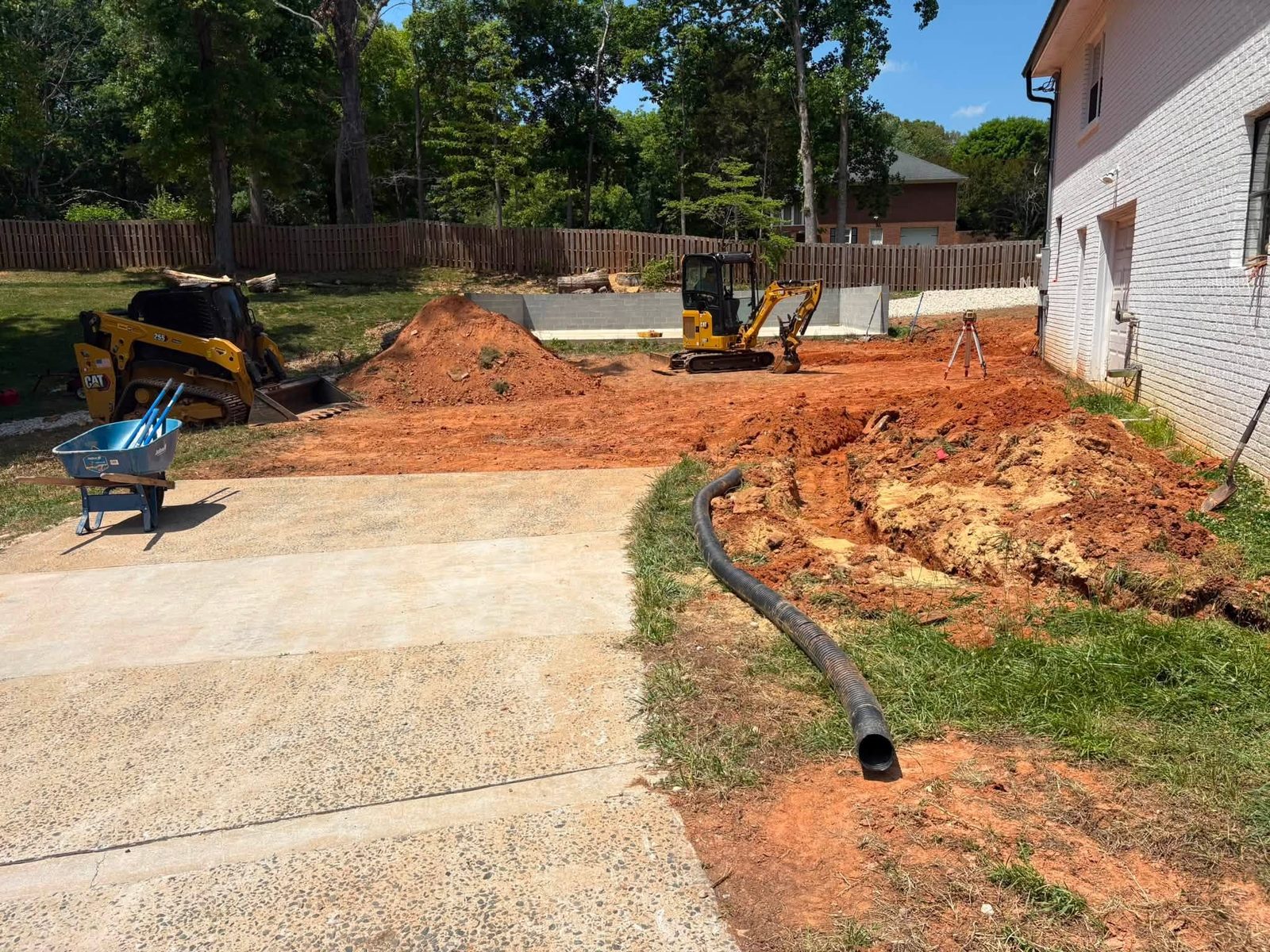
The practical consequence for retaining wall cost is direct: walls on clay typically require a compacted gravel drainage layer behind the block face, perforated drain pipe at the footing, and on taller walls, geogrid reinforcement layers pulled back into the slope fill. Leave out any one of those elements and the wall is a repair waiting to happen. Homeowners already seeing runoff damage on their slope should read the yard erosion and gully repair guide before committing to wall construction — sometimes the right fix is a graded swale alongside the wall, not instead of it.
Forsyth County also sits in a broader stormwater context that makes drainage engineering non-optional: 22 federally declared disaster events affect the county (1977-2026), most of them storm and flooding related. That history is a record of what the clay-and-slope combination does under significant rainfall. A retaining wall that cannot drain fast enough becomes a dam, and a dam that fails puts the yard and structure below it at risk.
Permits, erosion rules, and Forsyth County code requirements
Retaining walls above a certain height require a building permit in North Carolina, and Forsyth County enforces that threshold. The residential code trigger is generally four feet of exposed wall height measured at the lowest adjacent grade. Anything at or above that line requires stamped engineering drawings, a permit pulled before work begins, and inspection sign-off before the project closes. Forsyth County building services is the right first call when a proposed wall height puts the project in question.
Grading and earthwork also trigger erosion and sediment control obligations under the NC DEQ Erosion and Sediment Control program. Projects disturbing more than one acre require a formal approved plan before ground breaks. Smaller residential retaining wall jobs fall under the state's general sediment control standards, which require basic protective measures during active construction — silt fencing, stabilized staging areas, and inlet protection at nearby storm drains. Contractors who skip those steps on sloped lots put clients at risk of state notices and remediation costs that exceed what the protective measures would have run.
Where a project involves work near a defined drainage channel or a mapped floodplain, stormwater permitting rules tied to the EPA's NPDES program may also apply. A contractor fluent in Forsyth County's permit process will surface that question during project scoping, not after excavation has started and the drainage corridor is already disturbed.
Matching the material to the grade and the soil
Segmental concrete block is the workhorse material for Forsyth County retaining wall jobs, and for straightforward reasons: it is readily available, dimensionally consistent, and fully compatible with the geogrid reinforcement systems that handle lateral loads from Piedmont clay. The engineering is well-documented and the labor supply is steady. For walls under four feet on lots with manageable grades, segmental block is almost always the right call and prices in the lower half of the installed range.
Natural stone and boulder walls occupy the upper portion of the range not because the material is inherently stronger, but because the installation labor is slower and the drainage systems behind dry-stacked stone require more careful execution to prevent hydrostatic buildup. On properties where a wall is highly visible — a front-yard grade change in a neighborhood with mature trees — the premium often holds its value. For walls that are primarily structural and mostly hidden by landscaping, building to the top of the range is rarely necessary.
Gabion walls, wire baskets filled with stone, appear occasionally on projects where flexibility under ground movement is a design feature. They are typically mid-range on installed cost and well-suited to sites with active water flow at the base of the wall. The retaining walls guide covers block, stone, timber, and gabion options side by side with guidance on matching each to specific grade and soil conditions.
Reading a retaining wall bid in clay country
Three questions protect you when comparing quotes in Forsyth County:
- Ask where the water goes before the wall. Every bid should answer the drainage question before any conversation about block type or finish. Drainage in Piedmont clay is not an optional component — it is the mechanism that keeps a wall functional through its second and third decade. If the drainage answer comes after the price, put that bid at the bottom of the stack.
- Request a line item on drainage components. Gravel backfill, filter fabric, perforated pipe, and a daylighted outlet each carry a cost. Separating them out makes different bids comparable on equal scope and protects you from change orders once digging has started and the clay layer is exposed.
- Match the proposed height against the permit threshold. If a wall comes in at three feet ten inches on a slope that visually needs four feet or more to hold the grade, ask the contractor to explain the measurement. An unpermitted wall that should have required engineering is the seller's liability at the next real estate transaction and the homeowner's repair after the next wet winter.
If the slope is already moving before wall construction begins, coordinate the structural fix with uphill stabilization. The erosion control guide covers soil stabilization methods, seeding programs, and drainage sequencing that protect a finished wall from the uphill problem it was built to hold back.