Piedmont clay and disrupted subdivision grades — the drainage reality behind most Advance calls
Advance, NC sits on the eastern edge of Davie County, roughly fifteen miles southwest of Winston-Salem. The housing stock here is dominated by subdivisions built on former agricultural land from the late 1990s through the 2010s — and that origin story shapes almost every drainage problem in the zip code. When cropland gets subdivided, builders grade flat pad sites, install cul-de-sacs, and establish finished grades that look correct at certificate of occupancy. What those grades rarely account for is what happens two or three years later: soil settles, sod establishes low spots, neighbors add fences that redirect sheet flow, and the original drainage pattern — the one that kept that farmland dry for decades — is gone.
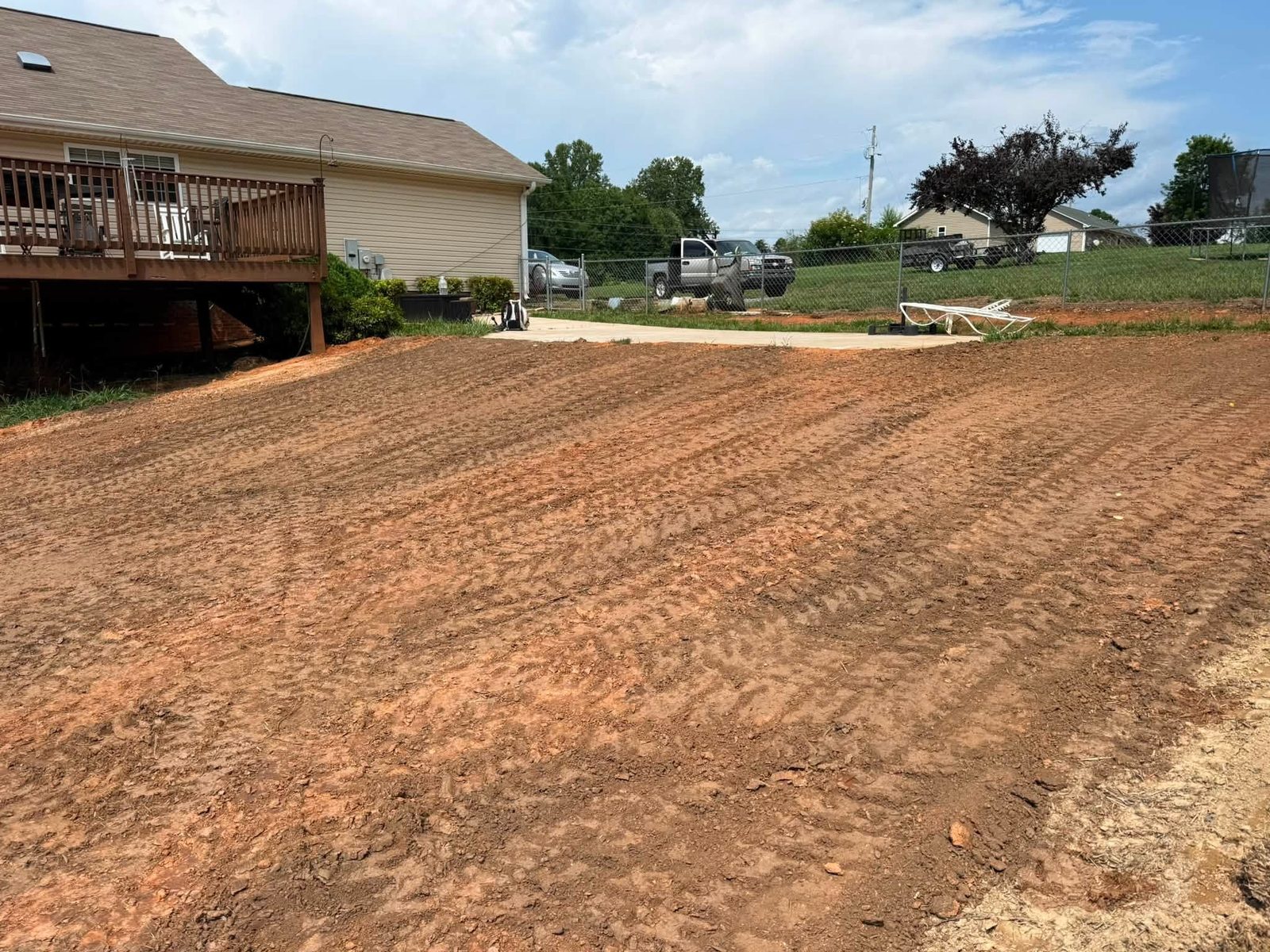
Davie County's soils sharpen the problem. The red-orange clay that underlies most of the county has low permeability; surface water after a normal storm can sit for 24 to 48 hours in problem areas before it moves. That is not a catastrophe — it is just clay behavior — but it means drainage solutions here need to be sized for slow-moving soil water, not just fast surface runoff. A French drain designed for sandy Coastal Plain conditions will underperform in Advance. The right system starts with an honest read of where water enters, where it collects, and where it can legally leave the property.
What the work actually involves — from trench to outlet
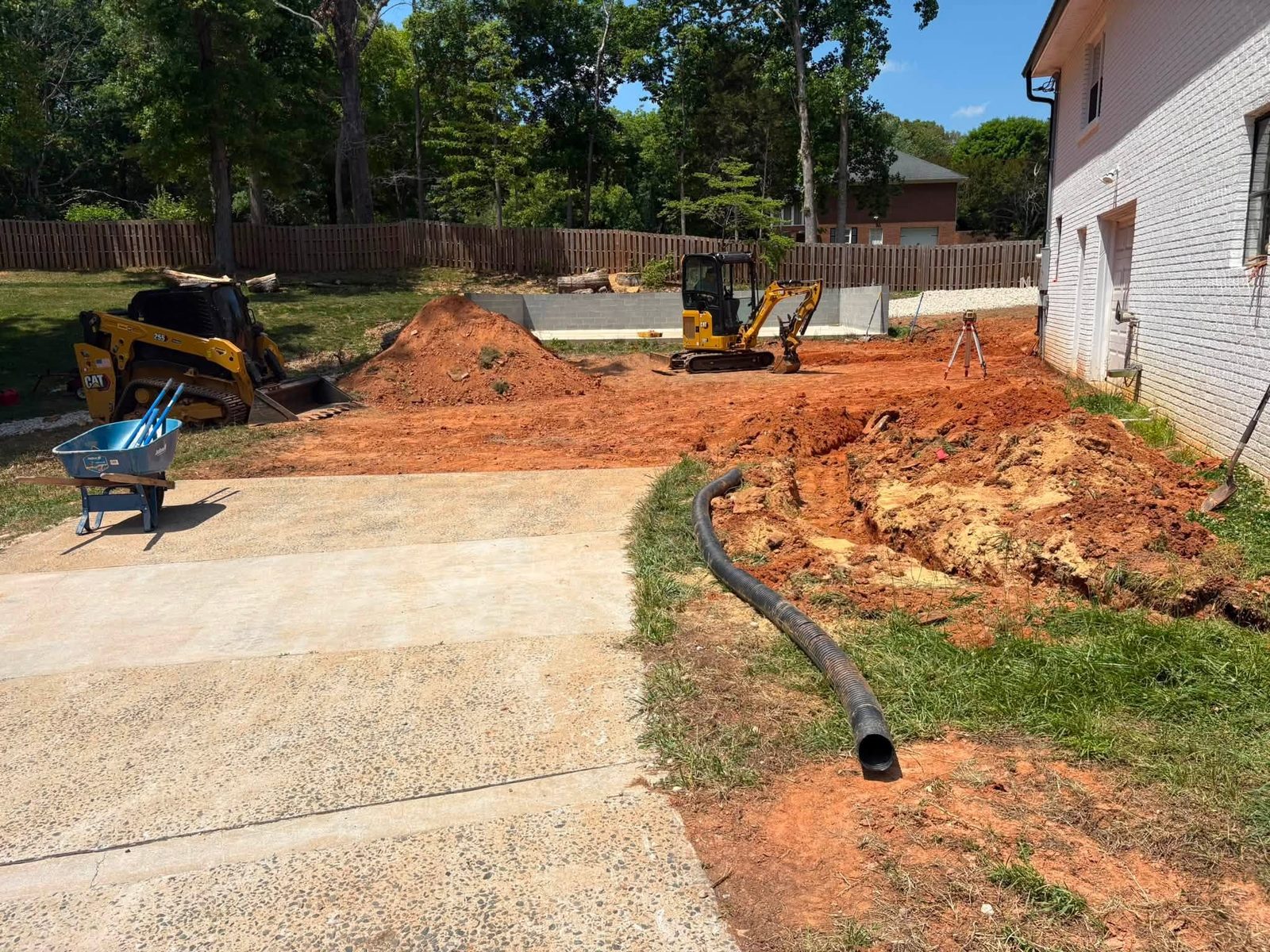
A French drain intercepts groundwater and surface water along a gravel-filled trench and routes it through perforated pipe to a discharge point. The design question that separates a durable system from one that backs up in two years is outlet location. Advance lots that border a wooded buffer or a roadside swale have a natural answer. Lots surrounded on all sides by other subdivision lots require careful engineering of the outlet grade and sometimes a long pipe run to reach the curb line or a shared drainage easement.
Most single-run jobs — from collection area to outlet, 50 to 80 linear feet — fall in the $3,000 to $6,000 range depending on trench depth, pipe diameter, and what the crew has to work around. Multi-zone systems that handle several collection areas and channel them to a shared main line climb toward the upper end of the residential range. For a full line-item breakdown by scope, the French drain cost page covers what each component adds to the total. If your yard holds water in more than one spot after a normal rain, the standing water guide walks through how to read the pattern before you call for bids.
Scope and cost ranges for Advance, NC drainage projects
The ranges below reflect typical Davie County conditions: clay-heavy soils, subdivision lots, and standard equipment access. Jobs with unusual outlet complexity, deep utility conflicts, or significant fill requirements sit at the high end of their row or above it.
| Scope | Typical Cost Range |
|---|---|
| Single French drain run (50–80 ft) | $3,000–$6,000 |
| Downspout extensions to grade outlet | $400–$1,200 |
| Catch basin with inlet and piped outlet | $1,200–$2,800 |
| Multi-zone collection system, shared main | $5,500–$9,000 |
| Full residential drainage system (whole yard) | $7,000–$12,000 |
| Whole-yard regrading (equipment, fill, topsoil) | $15,000+ |
Regrading jobs that cross into significant land disturbance bring permit and erosion-control requirements into play — covered in the section below.
Storm history and what Davie County's record means for your drainage plan
Davie County has recorded 19 federally declared disasters over a 1977-2026 span, most of them storm and flood events connected to the Yadkin River corridor along the county's western edge. Most residential drainage problems in Advance are not riverine — they are upland accumulation issues on clay-heavy subdivision lots. But the federal record matters for one practical reason: it tells you this is a county where storm hydrology has been studied and mapped. Before siting a drain outlet near any low-lying area or accepting a discharge plan that routes water toward a drainage feature, check your parcel against the FEMA Flood Map Service Center to confirm the outlet location does not fall inside a mapped flood zone. A discharge point that backs up during a declared-event storm is not an outlet — it is a liability.
Permits, erosion rules, and what NC requires before work starts
Most residential French drain installations in Advance fall under the one-acre land-disturbance threshold that triggers mandatory permitting under NC's statewide program. But any drainage work that involves significant regrading, redirects runoff toward a neighbor's property, or ties into a public stormwater system may still require a county grading or land-disturbance permit. The NC DEQ's Erosion and Sediment Control program sets the statewide floor for what contractors must do when soil is disturbed, and the EPA's NPDES stormwater program applies at scale to any project that crosses the one-acre trigger.
Advance sits close to the Forsyth County line, and a handful of parcels in the eastern part of the community fall under Forsyth County jurisdiction rather than Davie County's. If your property address is near that border, confirm with the correct county planning department before pulling permits. The practical minimum for any drainage job, regardless of permit status: the outlet must discharge to a legal point, finished grades must drain away from the foundation at the slope the IRC requires, and no runoff may be directed onto a neighbor's property without a recorded easement.
What separates a durable drainage crew from a trench-digger
Clay-soil drainage rewards contractors who understand material behavior, not just excavation depth. When perforated pipe is backfilled in heavy Piedmont clay without a properly sized gravel envelope and geotextile separation fabric, clay fines migrate into the stone within a few rainy seasons and reduce flow capacity. Ask any crew you are evaluating to describe their aggregate specification and how they prevent fines migration — that single question separates contractors who have worked Davie County clay from those who learned drainage on coastal sandy soil.
Beyond materials, ask for a defined outlet plan before signing anything. If the outlet location is listed as "to be determined on site," the quote is not complete. The crews worth hiring will walk you to the proposed outlet during the estimate and explain exactly where water exits your property and where it goes from there. A contractor who cannot answer that question clearly has not solved your drainage problem — they have offered to move it somewhere else on your lot.